THE HEALTHY LIVING JOURNAL
How to Choose a Safer Walking Route: Sidewalks, Crossings, and Everyday Details
Look beyond distance when planning a walk. Review surfaces, traffic crossings, lighting, and useful places to pause before making a route your regular choice.
General educational information · Sources listed below
Look beyond the distance on a map
A route can look convenient on a phone and feel very different on foot. A short loop may include a difficult crossing, a sidewalk that disappears, or a driveway where cars reverse into your path. Choosing a regular walk is therefore partly a route-planning task. The goal is a practical option you can use with confidence, while recognizing that no route removes every hazard.
Begin with two or three possibilities close to home, work, or another place you already visit. Consider a park path or a continuous neighborhood sidewalk as well as a direct street route. Compare the whole experience, including the walk from a parking area or bus stop. A slightly longer trip to reach a better path may be worthwhile.
Check the walking space from start to finish
NHTSA recommends using sidewalks when available. Where there is no sidewalk, it advises walking facing traffic and as far away from vehicles as possible. For a regular exercise route, look first for an option that gives you a continuous place to walk without repeatedly stepping into the roadway.
Notice narrow sections, blocked paths, broken pavement, curb ramps, and changes in surface. Think about whether the route works with any mobility aid you use and whether two people can pass comfortably. A path that suits you in dry daylight may be harder after rain or when leaves cover the ground. Look at the return journey too; a one-way impression can miss a problem.
Treat crossings as a separate decision
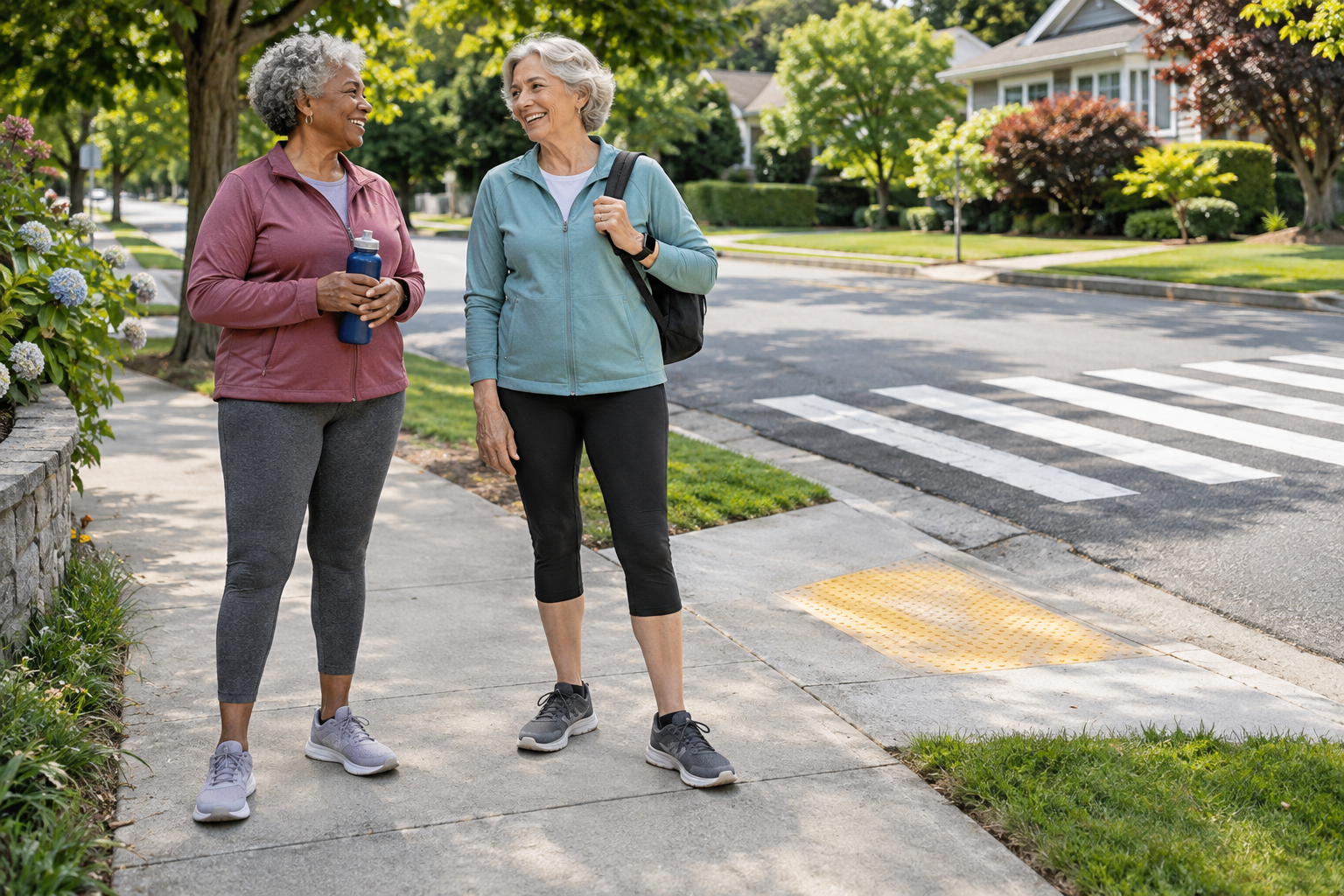
Review every street crossing before adopting the route. NHTSA advises crossing at crosswalks or intersections, following signs and signals, and watching for turning vehicles. A painted crosswalk is not a guarantee that a driver has seen you. Wait for a clear, complete stop and make eye contact when possible.
Ask whether you can see approaching traffic from a place set back from the road. Parked vehicles or plants may block the view. If the road feels too wide or the signal does not give you a comfortable opportunity to cross, look for another route. You do not have to keep an awkward crossing simply because the rest of the loop is pleasant.
Try it at the time you expect to walk
NHTSA’s walkability checklist encourages assessing routes and recording specific problems. Use that idea for a short trial at your usual walking time. A quiet street on Sunday morning may have busy driveways during a weekday commute. School arrival, delivery traffic, or a crowded parking lot can change how the same area feels.
Observe lighting, shade, places to pause, and how easy it would be to shorten the walk. These details can affect whether you want to repeat it. If you walk with a friend, compare what each of you noticed afterward. Avoid taking notes or looking at a map while moving through a crossing; stop somewhere out of the way first.
Make a backup plan for changing conditions
Consider a shorter version that turns back before the most demanding section, and identify an alternative for poor weather or construction. A familiar route still needs a fresh look. Temporary signs, parked trucks, fallen branches, snow, and damaged pavement can change the space available.
Check current local conditions before leaving and choose a different time or place when needed. Bring what makes sense for the setting and your needs, such as a phone and identification, but keep attention on the surroundings. At driveways and parking areas, watch for vehicles backing or turning even when you have used the route many times.
Keep a simple route note and report problems
A useful route note can be brief: where it starts, which crossing to use, where the uneven section is, and how to return early. You could also record whether there is a bench, restroom, or open public building nearby. Treat these as details to verify rather than assuming they will always be available.
For a persistent hazard, give the appropriate local transportation, parks, or public works office a precise location and description. NHTSA’s checklist includes ways communities can address walkability problems. Meanwhile, choose the option that fits your current abilities. CDC recommends enjoyable activities that match those abilities; a workable route helps turn that advice into an ordinary, repeatable habit.
Explore the sources
- NHTSA: Pedestrian Safety ↗
- NHTSA: Walkability Checklist Guide ↗
- CDC: Adding Physical Activity as an Adult ↗
Prepared with AI assistance for True Healthy Products LLC. Sources inform this educational guide; their inclusion does not imply endorsement of our company or products. See our editorial approach.