THE HEALTHY LIVING JOURNAL
Skin Self-Checks: What to Notice and How to Prepare for a Dermatology Visit
Learn a consistent way to look at your skin, record changes clearly, and understand why a self-check cannot diagnose a spot.
General educational information · Sources listed below
Know the purpose of a self-check
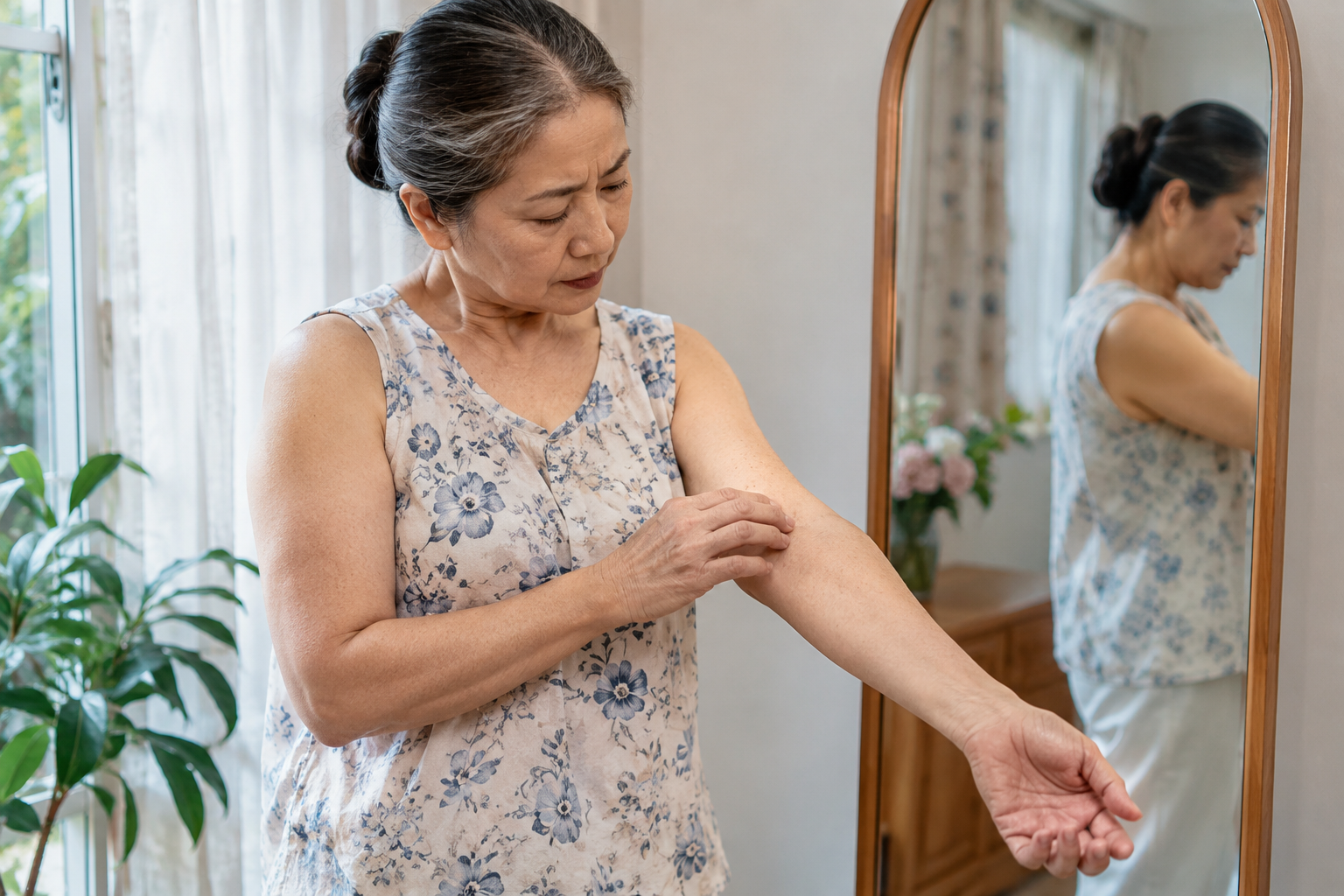
Looking at your own skin can help you notice a new or changing spot and describe it to a dermatologist. It cannot tell you with certainty whether a spot is harmless or cancerous. The useful outcome is a clearer observation and appropriate follow-up, not a diagnosis made from a mirror or an online photograph.
The American Academy of Dermatology recommends regular skin self-exams and notes that skin cancer can affect people of any skin color. It advises seeking a dermatologist for a spot that differs from others, changes, itches, or bleeds. Do not wait for every item on a checklist to appear before asking about a concern. [1]
Choose a private, well-lit place where you can look without rushing. Gather a full-length mirror, a hand mirror if available, and a way to make notes. If balance or movement is difficult, adapt the setup and ask for help rather than trying to twist or stand unsteadily to see a particular area.
Use the same route each time
A consistent order can make it easier to remember which areas you have checked. AAD describes looking at the front, back, and sides of the body, then checking arms, hands, legs, feet, scalp, and other hard-to-see places. Mirrors or assistance can help with areas you cannot see directly. [1]
Do not turn the check into a flexibility challenge. You can make a note that an area needs assistance or a professional look. If someone helps, explain what you want them to observe and respect your own privacy and comfort. An incomplete view is information to address, not a reason to attempt an unsafe position.
Understand the ABCDE reminder
AAD's ABCDE guide calls attention to an uneven shape, an irregular edge, different colors within a spot, diameter, and evolution over time. Melanomas are often larger than a pencil eraser when diagnosed, but they can be smaller. Size alone therefore cannot rule out a concern. [2]
Evolution means a change in appearance, including size, shape, or color. A spot that looks unlike your other spots also deserves attention. Use the reminder to organize what you have noticed, not to score a lesion as safe. A description such as 'new dark spot on the left forearm' is a useful starting point for contacting a clinician. [2]
Record location and change clearly
Write down where the spot is and what drew your attention. Include when you first noticed it and any symptom you can describe. Avoid guessing a diagnosis in your notes. A short, specific description is easier to use later than several pages of copied internet possibilities that may not apply to your skin.
If you choose to take a personal reference photograph, record the date and location and keep it private. A photograph is a communication aid, not proof that a spot is stable or harmless. Differences in lighting or angle can make comparison difficult. Ask the dermatology office how it prefers to receive information rather than sending sensitive images through an unfamiliar service.
Arrange care for a concerning spot
AAD advises prompt dermatology attention for moles or pigmented spots with concerning ABCDE features. It also highlights new, changing, different, itching, or bleeding spots. A self-check should move you toward that conversation rather than repeated home monitoring when you already have a concern. [2]
When contacting the office, describe the location, change, and symptoms plainly. Ask what to do while waiting and how to report further changes. If access is difficult, ask your usual health care provider about a suitable route for assessment. Do not attempt to remove, burn, or chemically treat a suspicious spot yourself.
Prepare a few questions for the visit
Bring your observations and the date you first noticed the issue. Useful questions include which changes should prompt another call, whether an area needs monitoring, and what follow-up is appropriate for your personal history. The clinician can explain what an examination can establish and whether anything further is needed.
You can also ask how often to perform your own checks and whether anyone should help with areas you cannot see. A general article cannot assign an individual examination schedule. Your history, current findings, and ability to check your skin all belong in that discussion rather than a one-size-fits-all calendar rule.
Keep familiarity separate from reassurance
Knowing your skin can make a change easier to notice, but familiarity does not guarantee that every spot is harmless. Continue using a consistent, comfortable approach and bring concerns forward. Avoid comparing your skin only with dramatic online examples, which may not resemble the reason you need an examination.
The most useful habit is observation followed by appropriate action. A mirror, a simple note, and a timely question can support that process. They work best when paired with professional assessment of concerning changes, rather than trying to replace it.
Explore the sources
- American Academy of Dermatology: Skin Self-Exam ↗
- American Academy of Dermatology: ABCDEs of Melanoma ↗
Prepared with AI assistance for True Healthy Products LLC. Sources inform this educational guide; their inclusion does not imply endorsement of our company or products. See our editorial approach.